
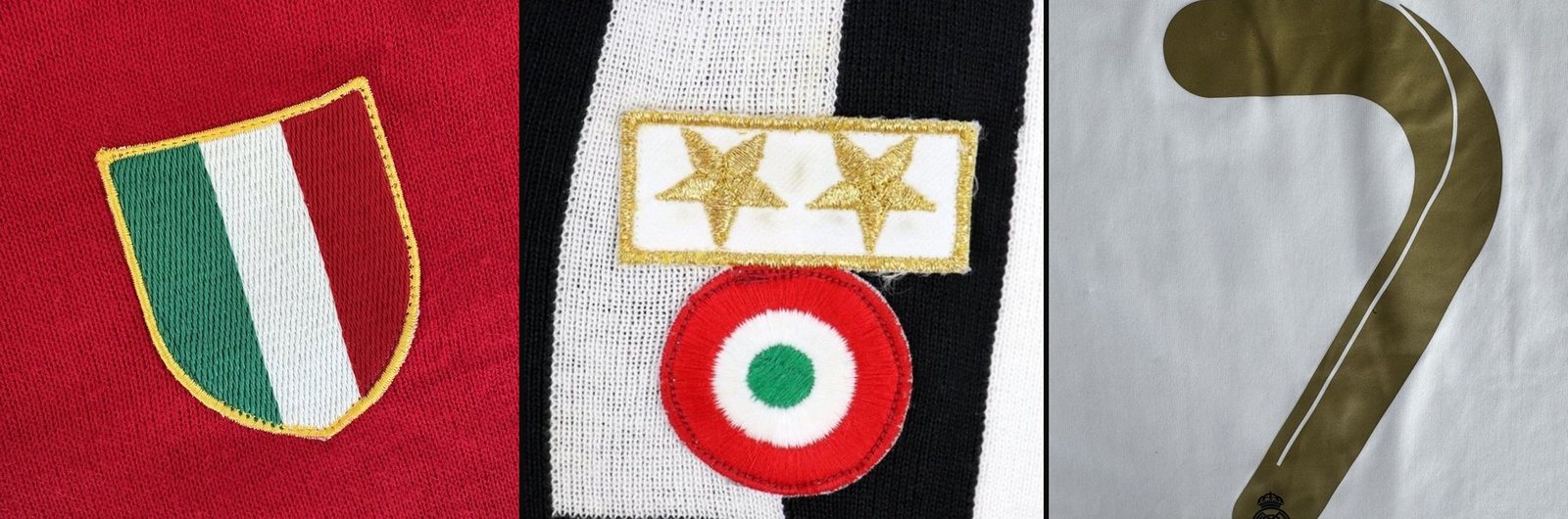
- A match worn shirt was worn by a player in an official game: it is the rarest category.
- Its value depends on proof: photos or video from the game, direct provenance from the club or player, certificates.
- Labels, patches, numbers and signs of wear must match images from the game.
- Be wary of prices that look too good and stories with no documents.
Every collector knows the feeling: a shirt with a champion's name and number, and the urge to buy it right away. But the same shirt can exist in very different versions, and only one of them actually went on the pitch. Knowing the difference is the first step to buying with confidence and to avoid paying for a replica at the price of a historic piece.
Match worn, match issued or replica: the differences
The memorabilia market uses a few precise terms. They are worth knowing, because they describe objects with very different stories.
On Memorabid the title of each lot states which one it is: match worn, prepared or store shirt. Reading it carefully is half the job.
Details to check on an authentic shirt
No single element is enough on its own. Authenticity is built by putting together several clues that agree with each other.
Cut and fabric
Match shirts are often made with different fabrics and cuts from the retail version, lighter and closer-fitting. Compare the shirt with close-up photos from the same season and the same type of competition.
Patches, sponsors and numbers
League, European cups and finals use different patches. Sponsors can also change during a season. Number, name and font must match those used in that game: one detail out of place is a warning sign.
Inner labels and codes
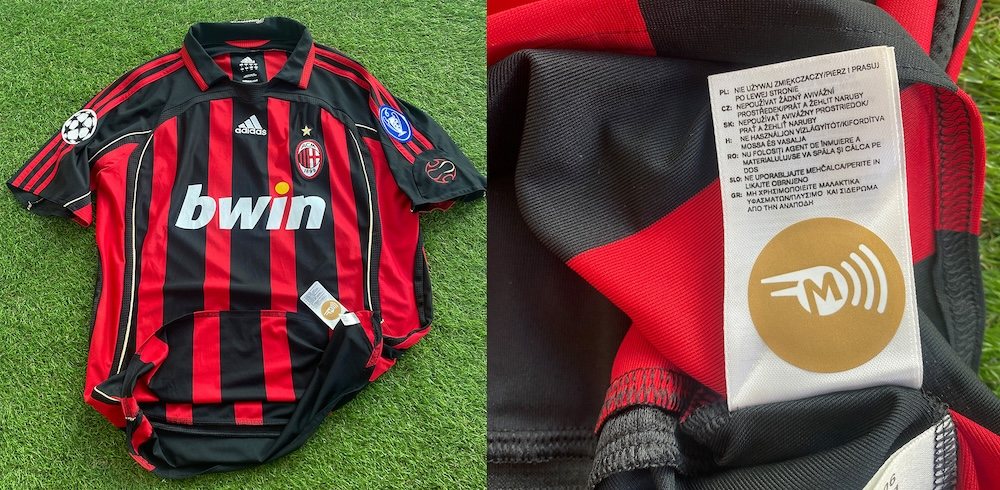
Many clubs and kit suppliers add internal labels or codes to shirts made for the team. Check that they are there, readable and consistent with the season.
Signs of wear
A worn shirt may show traces of play: stains, pulled threads, grass marks. They are not a defect, but they must be consistent with the game stated.
Photo proof, video and provenance
The strongest evidence is photo or video proof: images showing the player in that exact shirt, in that game, or the moment the item is handed over or signed. When a unique detail (a crease in a patch, a mark on the number) appears both on the shirt and in the match photo, collectors call it a photo match.
Next comes provenance: a shirt that comes straight from the club, the federation or the player has a traceable history. Always ask where the piece comes from and who owned it before.
Certificates of authenticity and NFC tags
A certificate is only as good as whoever signs it. A generic sheet, with no reference to the item and no identifiable issuer, says very little. A good certificate describes the item, includes its images and can be verified.
On Memorabid, winners of a Memorabid Auction can request the COA, Certificate of Authenticity, at checkout. For Marketplace Auctions the COO, Certificate of Origin and Provenance, confirms the item was bought at auction on Memorabid. Both are linked to a serial code and two NFC tags: one on the paper certificate and one inside the item. Hold your phone close and you open the digital version, with every photo and the full description of the lot.
See how NFC certificates workCOA and COO, on paper and on your phone.Red flags you should not ignore
- A "worn" shirt of a star at a price far below similar pieces.
- No photo proof and vague provenance ("from a kit man", "from a friend at the club").
- Patches, sponsors or fonts that do not match the stated game.
- A certificate with no description of the item, no images and nothing you can verify.
- A seller who avoids precise questions or rushes you.
How Memorabid handles shirts
In Memorabid Auctions, marked in gold, the items are already in our warehouse: we photograph them and the auction house guarantees every element described in the listing. In Marketplace Auctions, marked in blue, the team screens every seller and every auction in advance, and after the auction the lot still passes through our offices for a conformity check before it reaches you.
If the shirt is signed, the autograph must meet at least one of three requirements: photo or video proof, direct provenance from the athlete, club or federation, or a certificate from an international authority such as Beckett, PSA/DNA or JSA. If none applies, a court-appointed handwriting expert examines the signature before the item goes to auction. More on this in our guide to sports autographs.
Want the full rules? Read how Memorabid works or browse the live auctions.
Frequently asked questions
What is the difference between match worn and match issued?
A match worn shirt was worn in a game. A match issued, or prepared, shirt was prepared for a game with match patches and lettering but not necessarily worn.
Is a signed retail shirt worth anything?
Yes, if the autograph is genuine. Its value comes from the signature and the proof behind it, not from the shirt, which remains a retail model.
Is a certificate enough?
A certificate helps when it describes the item and can be verified. The strongest evidence is still photos or video from the game and a traceable provenance.
How do I check the certificate of a shirt bought on Memorabid?
COA and COO have a serial code and two NFC tags. Hold your phone to the tag to open the digital version with the photos and description of the item.
 Memorabid Editorial TeamThe team that selects, photographs and checks the items auctioned on Memorabid.